
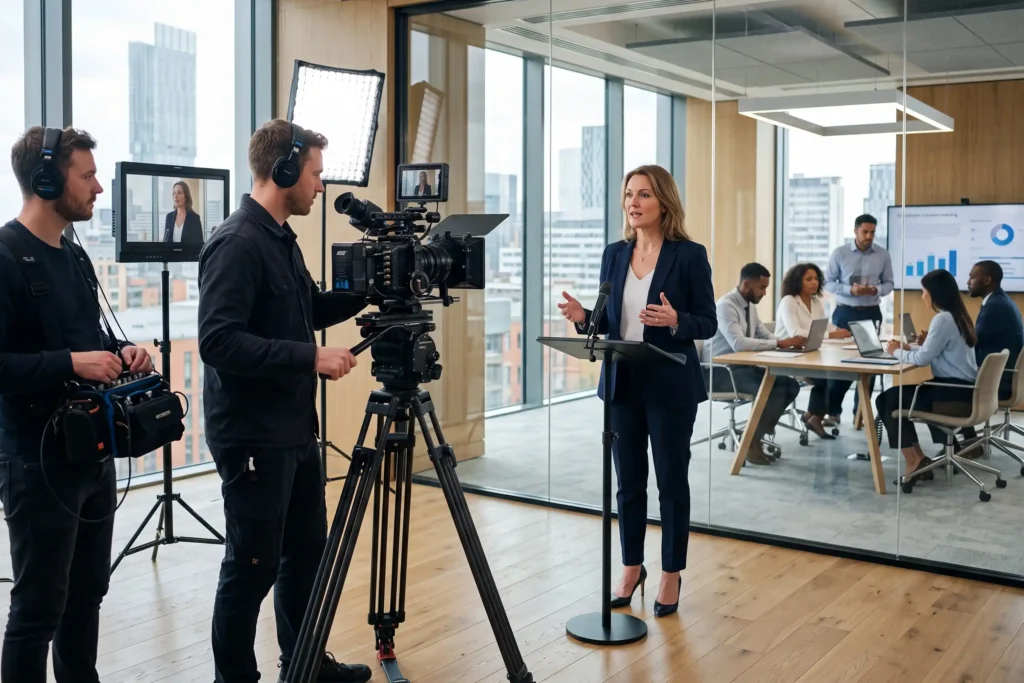
Corporate Video Production and Commercial Video Production.
Modern organisations rely heavily on visual communication to establish trust, attract investment, and maintain brand authority in competitive markets. High-calibre corporate video production provides a structured framework that translates strategic corporate goals into persuasive, high-impact screen assets. Whether launching a national infrastructure project or refreshing employer branding, executive leadership must ensure every film project is accountable to business outcomes. Aligning video messaging with formal corporate strategy protects brand reputation whilst ensuring clear communication across diverse internal and external stakeholder groups.
However, many corporate leadership teams struggle to distinguish between subjective artistic storytelling and commercially accountable video output, frequently risking substantial production budgets on misaligned visual formats. How can senior corporate decision-makers effectively combine strategic planning, regulatory compliance, and broadcast-level execution to guarantee a genuine return on their video production investment?
Key Takeaways
- Commercial video production aligns creative storytelling directly with measurable business objectives to reduce reputational risk and enhance long-term commercial impact across key channels.
- High-end brand film production establishes corporate credibility by maintaining consistent visual standards, clear narrative structures, and rigorous compliance across all distribution platforms.
- Evaluating video return on investment requires analysing indirect strategic benefits, such as accelerated deal velocity, improved stakeholder engagement, and reduced internal briefing time.
- Managing filming permissions through local film offices protects projects from costly delays, legal liabilities, and public disruption during urban location shoots across major cities.
- Deploying modular post-production edits allows organisations to maximise content lifespan, reduce reshoot risks, and efficiently support multi-channel communication strategies over several years.
Strategic Comparison of Commercial Video Formats
Selecting the appropriate video format depends on organisational goals, target audiences, and intended asset longevity. Commercial video assets range from conceptual brand messaging to tactical promotional cuts, each serving distinct business objectives. Establishing the core purpose early prevents scope misinterpretation and aligns production expenditure with realistic commercial outcomes.
The matrix below details key operational differences across primary commercial video categories. Comparing primary objectives, typical target audiences, and expected asset lifespans allows project stakeholders to evaluate format suitability before pre-production commences. This structured approach ensures resources are allocated effectively to generate maximum business value.
| Format Type | Primary Objective | Target Audience | Expected Lifespan |
|---|---|---|---|
| Brand Film | Long-term reputation and emotional values alignment | External stakeholders, investors, public | 3–5 years |
| Corporate Video | Operational clarity, trust, and business credibility | Clients, partners, procurement teams | 2–4 years |
| Recruitment Film | Employer branding and candidate attraction | Prospective employees, talent pools | 1–3 years |
| Campaign Video | Action, conversion, and immediate lead generation | Targeted marketing segments | 3–12 months |
| Technical Explainer | Simplifying complex systems or data frameworks | B2B decision-makers, internal teams | 2–3 years |

Commercial Alignment and Business Purpose
Commercial Objectives Versus Creative Storytelling
Commercial-first video production begins with a defined business outcome rather than an abstract narrative concept. Whilst creative storytelling engages viewers, commercial video framing prioritises messaging hierarchy, brand clarity, and risk management. Visual decisions are deliberately engineered to solve organisational challenges, ensuring creative choices consistently support quantifiable commercial goals.
When organisations treat video purely as an artistic exercise, messaging often drifts away from core priorities. A commercial agency establishes strategic guardrails during early discovery phases. This process defines target demographics, core value propositions, and success metrics before cameras arrive on location. Consequently, the finished asset speaks directly to target decision-makers, conveying competence and commercial authority.
ROI Metrics Across Business Functions
Evaluating return on investment in video requires looking beyond baseline view counts and surface-level social engagement. Senior leaders judge video efficiency through operational impacts, including reduced sales cycles, improved recruitment quality, and shorter onboarding times. A structured measurement model links visual content to specific performance indicators across individual departments.
For example, B2B sales teams use targeted video assets to pre-qualify prospects and address technical objections before formal meetings. In recruitment, high-quality employer brand content reduces candidate drop-off and lowers agency costs by attracting cultural fits. By framing video performance around efficiency gains and risk reduction, organisations justify production spend through tangible operational value.
Business Video Production
Multi-Channel Asset Suites
At Paper Films, we produce cinematic, commercially-focused corporate video for businesses across the UK. From national manufacturers to specialist SMEs, we create content designed to deliver results across every channel your business uses. Build Trust. Strengthen Your Brand. Create Content That Works Harder.
Differences Between Commercial Video Formats
Brand Films Versus Corporate Videos
Understanding the structural distinction between brand films and corporate videos prevents commissioning errors and ensures audience alignment. A brand film focuses on overarching values, emotional identity, and long-term reputation management. Conversely, corporate video production delivers direct operational clarity, explaining organisational capabilities, structure, governance, and commercial solutions to active commercial prospects.
Brand films usually employ cinematic visuals and conceptual themes to build trust over multi-year horizons. Corporate videos adopt a more pragmatic structure, often incorporating leadership interviews, operational footage, and client proof points. Both formats reinforce authority, but applying them to incorrect funnel stages leads to audience disengagement and diluted messaging.
Campaign Edits and Modular Content Strategies
Modern multi-channel marketing campaigns demand adaptable content architectures that extend beyond a single master video asset. Modular filming strategies capture diverse footage designed specifically for conversion into platform-specific edits, social teasers, and presentation clips. Planning these variations during pre-production maximises production efficiency and significantly reduces overall cost per deliverable.
A single hero shoot can yield a primary two-minute film alongside multiple 15-second social cuts, portrait versions for mobile channels, and silent caption-led clips. This modular approach allows sales and comms teams to deploy targeted assets across specific touchpoints. Extending asset utility enhances long-term return whilst keeping messaging consistent across all external channels.
Corporate & Brand
Strategic Storytelling
We craft intelligent brand documentaries and corporate films for global organisations. Moving beyond standard interviews, we use authentic, broadcast-quality storytelling to communicate complex values to investors, stakeholders, and internal teams.
Production Standards and Broadcast Expectations
Technical Indicators of Broadcast Quality
Broadcast quality represents a rigorous standard of technical compliance, creative control, and editorial safety required for high-stakes media environments. Achieving broadcast standards involves cinema-grade cameras, precise multi-point lighting, clean dialogue capture, and professional colour grading. These technical elements protect brand authority by eliminating visual clutter and amateur technical defects.
Audiences subconsciously associate poor lighting and muffled sound with organisational incompetence. High-end commercial video production ensures visual assets sit comfortably alongside broadcast media and national advertising campaigns. By applying broadcast tolerances, corporate visual communications withstand scrutiny from investors, board members, and national media outlets.
Crew Roles and Professional Workflow Governance
Separating production responsibilities into specialised crew roles is essential for managing delivery risks on commercial film sets. Assigning distinct personnel to directing, cinematography, sound recording, and lighting oversight ensures dedicated focus across technical and narrative details. Structured workflows establish clear sign-off points from pre-production scoping through to final quality assurance.
Relying on single operators for multi-faceted corporate shoots increases operational risk and reduces overall production value. Professional agencies utilise experienced crew setups to execute tight filming schedules without compromising safety or technical quality. Structured governance frameworks protect client timelines and guarantee consistent asset delivery across multi-location productions.
Commercial Advertising
Cinematic & High-Impact
We produce high-gloss TV commercials and digital campaigns designed to captivate and convert. Our team manages the entire creative journey, from storyboard to broadcast, ensuring your brand message is delivered with world-class production values that cut through the noise.
Regional Production Logistics and Compliance
Manchester Permit Frameworks and Location Access
Filming in major urban centres requires strict adherence to local council regulations and municipal permit application procedures. In Greater Manchester, commercial filming on public highways, green spaces, or council properties demands advance coordination with Screen Manchester. Securing official permissions prevents unexpected project shutdowns, legal disputes, and unnecessary public obstruction.
Low-impact handheld filming may occasionally proceed with simple notifications, but commercial shoots involving tripods, actors, or lighting rigs require formal permits. Applicants must supply risk assessments, method statements, and proof of public liability insurance. Engaging local film offices early ensures smooth access to iconic regional locations whilst maintaining legal compliance.
Drone Regulations and Urban Airspace Rules
Deploying aerial drones for commercial video footage requires full compliance with Civil Aviation Authority regulations and local airspace restrictions. Commercial drone operators must possess certified competency qualifications, valid operator registrations, and aviation-specific insurance cover. Densely populated urban environments demand careful flight planning and risk assessments to safeguard members of the public.
Flight paths near airports, major infrastructure sites, or emergency zones involve strict no-fly restrictions. Obtaining landowner permission for take-off does not supersede statutory CAA regulations. Professional video production agencies manage aerial permissions diligently, combining aerial perspectives with ground-based visual storytelling without exposing clients to regulatory penalties.
Production Support
Regional Crew & Logistics
We act as a trusted “boots on the ground” partner for international agencies and broadcasters filming in the North. We provide elite-level crew hire, location logistics, and technical support to ensure your UK production runs seamlessly.
Legal Duties, Risk Management, and Privacy
Health and Safety Duties on Location
Commercial production companies hold strict statutory responsibilities under UK health and safety legislation during location filming operations. Producers must carry out comprehensive risk assessments identifying electrical hazards, cable tripping risks, elevated platform dangers, and public boundary interface challenges. Implementing robust safety controls protects crew members, client representatives, and nearby pedestrians.
The Health and Safety Executive provides industry-specific guidance outlining risk reduction obligations for film sets. Working in active corporate offices, industrial sites, or transport hubs requires customised method statements and site inductions. Demonstrating rigorous safety protocols de-risks shoots for corporate clients and ensures seamless approvals from facility managers.
Data Protection and GDPR in Commercial Filming
Capturing recognisable individuals within video footage triggers legal data protection obligations under UK GDPR and the Data Protection Act 2018. Organisations publishing commercial video content must establish a clear lawful basis for processing personal data, securing signed appearance releases from featured individuals. Implementing transparent privacy notices safeguards organisations against data compliance breaches.
For background capture in public spaces, clear filming notices inform individuals that recording is taking place. Where employees or members of the public feature prominently, formal consent forms grant usage permissions across specific distribution platforms. Managing data rights systematically protects long-term asset usability and avoids privacy disputes.
Did You Know?
In Greater Manchester, commercial filming on council-managed public land or using professional equipment typically requires a permit issued via Screen Manchester, alongside public liability insurance of at least £5 million.
Sector-Specific Requirements and Sensitivities
Infrastructure and Housing Regeneration Delivery
Filming major infrastructure, housing development, and urban regeneration projects demands specialised stakeholder management and careful narrative control. Visual communication in this sector must balance ambitious place-making visions with pragmatic, factual reporting for local communities. Transparent storytelling avoids overclaiming whilst building genuine public trust across sensitive consultation processes.
Infrastructure environments involve strict personal protective equipment requirements, site inductions, and physical safety restrictions. Filming active transport networks or live construction zones requires close liaison with site engineers and transport authorities. Video content produced in these contexts must remain accurate, compliant, and sensitive to local community expectations.
Education and Public Sector Safeguarding Protocol
Video projects produced within educational institutions and public sector environments mandate rigorous safeguarding protocols and accessibility compliance. Recording children, young people, or vulnerable service users requires formal parental consent and strict data management practices. Furthermore, digital communications published by public authorities must meet official accessibility standards, including accurate captioning.
Public sector videos serve diverse audiences, requiring authentic representation alongside clear, plain language delivery. Scoping captions, audio descriptions, and transcriptions at project initiation avoids unexpected post-production expense. Adhering to government digital standards ensures public sector video content remains accessible, inclusive, and legally sound.
Post-Production Flexibility and Technology
Motion Graphics and Visualising Complex Data
Integrating 2D and 3D motion graphics transforms abstract technical systems, financial data, and future developments into engaging visual content. Motion graphics explain complex software architecture, engineering processes, or strategic roadmaps far more effectively than live-action footage alone. Overlaying animated elements onto live footage enhances viewer comprehension and maintains interest.
Whilst 2D animation provides rapid, cost-effective clarity for conceptual explainers, 3D visualisation delivers realistic spatial depth for architecture and infrastructure. Hybrid production models combine live interview credibility with animated graphics. This combination helps B2B software and manufacturing brands clarify sophisticated value propositions clearly to potential buyers.
AI Workflows and Extended Asset Lifespan
Incorporating artificial intelligence tools into post-production workflows accelerates editing, audio enhancement, transcription, and multi-platform versioning without sacrificing human creative judgement. AI-assisted processes streamline labour-intensive tasks such as dialogue isolation, auto-captioning, and social media resizing. Utilising AI tools protects client budgets whilst enabling rapid creation of diverse video variations.
AI functions best as a post-production accelerator rather than a replacement for strategic oversight. Human editors maintain control over brand tone, messaging accuracy, and emotional resonance. By deploying hybrid workflows, organisations refresh existing video assets efficiently, extending visual content lifespan whilst avoiding expensive reshoots.
Talk to Us About Your Project
If your business is looking for a strategic video production partner to support marketing, recruitment, communications or brand growth, we’d like to hear about your project.
We work with businesses at every scale — from single flagship films to ongoing content partnerships. Every conversation starts with understanding your objectives, not selling you a package.
Final Thoughts
Executing high-impact corporate video production requires combining creative visual storytelling with rigorous commercial strategy, regulatory compliance, and broadcast technical standards. Organisations that align video projects with clear business goals reduce reputational exposure whilst maximising asset utility across departments. Treating visual content as a strategic investment guarantees long-term engagement and measurable performance across competitive industries.
As media consumption patterns evolve, corporate leaders must adopt structured pre-production frameworks and flexible post-production workflows. Establishing robust compliance procedures, securing permissions, and planning modular content architectures will ensure visual brand assets remain current, lawful, and commercially effective for years to come.
Frequently Asked Questions
A:
A brand film focuses primarily on long-term brand identity, emotional values, and broad reputation management, often using conceptual visual storytelling to connect with wide public audiences. In contrast, corporate video production delivers detailed operational clarity by showcasing specific company capabilities, leadership expertise, governance structures, and B2B commercial solutions. This distinction ensures visual assets are deployed at the correct stage of the sales and communication pipeline.
A:
Commercial filming on public streets, parks, or council-managed land usually requires official permission from the relevant local film office or municipal council. Shoots using tripods, lighting rigs, actors, or drone equipment require formal permits, comprehensive risk assessments, and proof of public liability insurance. Conversely, minimal handheld filming with small crews may only require prior notification, depending on specific local highway regulations and location constraints.
A:
Video return on investment should be evaluated through both direct performance metrics and indirect operational impacts. Direct metrics include campaign lead generation rates, conversion increases, and email click-through metrics. Indirect ROI is assessed through reduced sales call lengths, shorter employee onboarding periods, improved recruitment candidate quality, and long-term asset reuse across multi-channel corporate campaigns over several years, lowering future content production costs.
A:
Commercial filming in public spaces or high-profile commercial locations generally requires Public Liability Insurance with a minimum cover threshold of £5 million. Complex shoots involving major city-centre public spaces, traffic management, heavy camera cranes, or elevated platforms frequently demand higher indemnity limits up to £10 million. Additionally, commercial drone operations require specialised aviation insurance compliant with Civil Aviation Authority operational requirements.
A:
UK GDPR applies whenever identifiable individuals appear within recorded video footage. Commissioning organisations must establish a lawful basis for processing personal data, typically by obtaining signed appearance release agreements from featured individuals. For background capture in public environments, clear filming notices must be placed around location perimeters informing passers-by of recording activities, intended media platforms, and relevant data protection rights.
Commercial video production
corporate video production
Commercial video production
corporate video production
Commercial video production
About The Author

Daniel founded Paper Films in Manchester over twenty years ago and continues to direct on every flagship project. He has built a reputation for translating complex B2B propositions into cinematic, commercially-focused films for organisations including BCN, Lancaster City Council and BAE Systems. Daniel’s direct involvement is built into every brief — strategy, scripting, on-set direction and final edit — so the work never passes to a junior team.
