
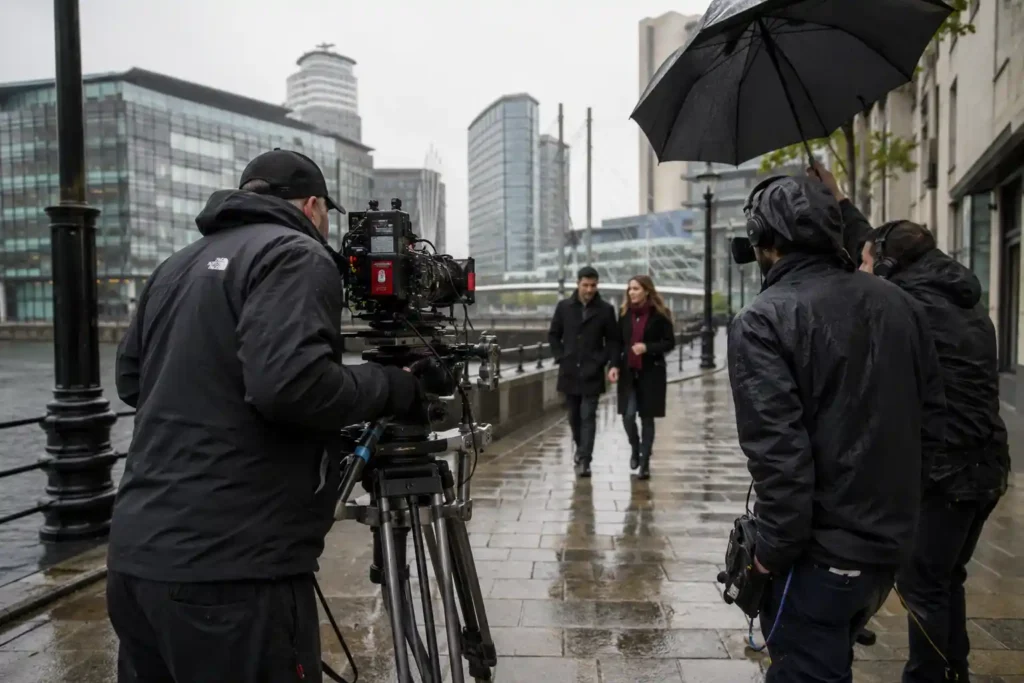
Manchester Film Production & Production Support.
Manchester film production has become one of the UK’s most capable regional industries. National brands, public sector bodies, and London agencies all commission work here. They want broadcast-quality output delivered on Northern ground. The city offers deep crew, strong infrastructure, and genuine operational agility. Yet location alone is never enough. Strong results demand the right production support and a trusted local camera crew.
National organisations filming in the North West face a recurring challenge. They want London-grade quality without London overheads. They also need compliance, logistics, and delivery handled by people who know the city. Could the right production support partner, backed by an experienced local camera crew, be the difference between a smooth shoot and a costly overrun?
Key Takeaways
- Manchester operates as a broadcast-grade production hub, anchored by the MediaCityUK and dock10 studios in Salford Quays.
- Production support manages logistics, filming permits, crew, and compliance on behalf of the agency leading a project.
- A local camera crew lowers travel costs and mobilises faster when reshoots or pickups become necessary.
- Screen Manchester coordinates commercial filming permissions and sets clear insurance and risk assessment requirements.
- National brands choose Manchester for regional authenticity, credibility, and content that withstands sustained commercial use.
Choose Manchester as a Broadcast-Grade Production Base
Manchester ranks among the UK’s most significant production centres. MediaCityUK in Salford Quays anchors the region. It houses major broadcasters and established production businesses. Purpose-built studios, deep post-production capability, and a strong talent pool sit alongside them. This makes Manchester far more than a location. It works as a fully operational, broadcast-grade production base.
The BBC’s relocation to Salford triggered wider creative industry growth. The local talent ecosystem expanded well beyond one broadcaster. Facilities such as dock10 offer purpose-built studios and in-house post workflows. Complex multi-platform productions can run without leaving the region. For national brands, broadcast-grade capability is a deliberate choice here. It rests on world-class infrastructure, not on compromise.
| Production Factor | Manchester Advantage |
|---|---|
| Studio infrastructure | Purpose-built facilities at MediaCityUK and dock10 |
| Crew availability | Dense local talent pool, faster mobilisation |
| Location variety | Urban, industrial, heritage, and countryside within close range |
| Cost efficiency | Reduced travel and accommodation versus London crews |
| Broadcast credibility | BBC presence drives sector-wide standards |
| Permit support | Screen Manchester coordinates commercial filming permissions |

Deploy Production Support for External Agencies
Define What Production Support Actually Delivers
Production support is not simply crew hire. It is a structured, end-to-end service. A local Manchester partner manages on-the-ground execution for the agency or broadcaster leading the project. The work covers location logistics, permit coordination, crew management, health and safety oversight, and stakeholder liaison. Experienced local people handle every stage.
Production support removes the burden of running an unfamiliar city. The partner handles access coordination with venues, councils, and site managers. They manage risk assessments. They ensure compliance with the conditions attached to filming permissions. Crucially, they act as a professional extension of the lead agency’s team. They do not push their own agenda. The best relationships stay invisible to the end client. The agency looks seamless, and the work gets delivered without drama.
Cut Costs and Risk with a Regional Partner
London agencies use Manchester production partners for two clear reasons. The first is cost efficiency, the second is delivery certainty. Sending a full London crew north adds travel, accommodation, and logistics costs. A strong local partner removes that overhead. It also matches, or exceeds, the production standard the agency promised its client.
Cost alone does not drive the decision. Risk reduction matters just as much. Local partners already understand Manchester’s filming constraints, permit requirements, and location sensitivities. They mobilise faster for pickups, resolve access issues without escalation, and manage the unexpected with local knowledge. As a result, London agencies protect client relationships through smooth, reliable delivery.
Secure Filming Permits Across Greater Manchester
Apply Early When Filming on Public Land
Screen Manchester coordinates filming permissions for commercial shoots. It operates under Manchester City Council. Any production using tripods, lighting rigs, or professional equipment on public land must engage it in advance. This includes streets, squares, parks, and civic spaces. Most applications require public liability insurance, usually a minimum of £5 million, plus a full risk assessment.
Productions that skip this step face real consequences. Delays, enforced shutdowns, and reputational damage all follow. Professional agencies treat permit coordination as standard pre-production work. Screen Manchester also handles road closure applications and traffic management approvals. It coordinates with Transport for Greater Manchester where shoots affect transport infrastructure. Allow 10 to 20 working days for complex applications.
Comply with Drone Regulations Before Any Aerial Work
Drone filming in Manchester is tightly regulated. It needs far more than local permission. All commercial drone operations must comply with Civil Aviation Authority rules. That means registered operators, certified pilots, and UK Uncrewed Aircraft Systems compliance. Manchester’s urban density adds further constraints. Flights near buildings, crowds, or city-centre sites require advanced operational risk assessments.
Screen Manchester’s Code of Practice sets specific documentation requirements for drone requests. These cover pilot credentials, flight plans, and combined risk assessment and method statements. Manchester Airport’s airspace creates controlled zones across much of Greater Manchester. The bottom line is simple. Landowner permission does not override CAA airspace rules. Any partner offering drone work without referencing CAA compliance should raise an immediate red flag.
Commercial Advertising
Cinematic & High-Impact
We produce high-gloss TV commercials and digital campaigns designed to captivate and convert. Our team manages the entire creative journey, from storyboard to broadcast, ensuring your brand message is delivered with world-class production values that cut through the noise.
Build a Reliable Local Camera Crew in Manchester
Match Crew Configuration to Production Scale
A professional local camera crew suits the project itself. Scale, environment, and output requirements drive the configuration, not simple availability. Broadcast-level work usually separates the roles clearly. A director or producer leads. A dedicated cinematographer shoots. A sound recordist captures clean dialogue independently. Lighting specialists manage controlled exposure. This separation reduces delivery risk.
An established Manchester partner gives you crews who already know the city. They understand where natural light fails in the centre. They know which venues limit power access and they manage public areas without disrupting passers-by or triggering permit problems. Local crews also mobilise faster for pickups and reshoots. That speed protects budgets directly when schedules shift.
| Crew Role | Core Responsibility |
|---|---|
| Director or producer | Leads the shoot and protects the agreed brief |
| Cinematographer | Captures controlled, broadcast-grade images |
| Sound recordist | Records clean dialogue independently of camera |
| Lighting specialist | Manages exposure and consistency across locations |
Verify Crew Credentials Against Compliance Needs
Crew verification matters most in regulated work. Public spaces, sensitive sites, and restricted sectors raise the stakes. Infrastructure and transport shoots may need site-specific inductions, PPE compliance, and method statement sign-off before cameras roll. Education and public sector environments demand DBS-checked crew. Clear safeguarding protocols apply wherever students or vulnerable people may appear.
The Health and Safety Executive publishes guidance for film, television, and broadcasting. It sets out legal duties to reduce risk to crew and the public. A genuine Manchester partner treats compliance documentation as standard, not exceptional. Strong credentials protect more than the shoot. They protect the commissioning organisation’s reputation if any incident or challenge arises.
Corporate & Brand
Strategic Storytelling
We craft intelligent brand documentaries and corporate films for global organisations. Moving beyond standard interviews, we use authentic, broadcast-quality storytelling to communicate complex values to investors, stakeholders, and internal teams.
Treat Commercial Video Production as a Business Investment
Position Video as a Strategic Asset, Not a Creative Expense
Commercial video delivers measurable value when it answers defined business objectives. Vague creative briefs rarely do. Organisations that set success criteria before filming gain far more return. They might target stakeholder comprehension, better recruitment applications, reduced briefing time, or campaign conversion. Video then becomes a strategic asset rather than a disconnected creative exercise.
Paper Films, based at Sun House on Little Peter Street in Manchester, works exactly this way. Every project starts with a discovery phase. That phase defines the commercial objective, target audience, and success criteria first. Post-production then delivers content aligned with the brief. Expensive reworking becomes far less likely. Video ROI rarely rests on immediate sales alone. It also reflects time saved, clarity achieved, and risk reduced.
Calculate the Real Cost of Poor-Quality Production
Poor or misaligned video carries costs well beyond the invoice. Reshoots, extra editing, replacement campaigns, and damaged credibility all add up. These losses often exceed the original budget. A video that fails to communicate does more than underperform. It creates fresh work. Teams revert to manual explanations and repeated briefings to fill the gap.
This is why broadcast-level standards work as risk management, not prestige. Broadcast-quality content withstands external scrutiny. It functions across multiple platforms and audiences. It stays usable for two to five years, depending on content type. The higher upfront cost buys longevity, reuse, and reputational safety. Content that holds up under sustained use earns back its investment.
Production Support
Regional Crew & Logistics
We act as a trusted “boots on the ground” partner for international agencies and broadcasters filming in the North. We provide elite-level crew hire, location logistics, and technical support to ensure your UK production runs seamlessly.
Apply Sector-Specific Standards to Manchester Productions
Conduct Pre-Production Differently for Regulated Environments
Regulated sectors demand stricter pre-production discipline. Transport infrastructure, public sector, education, and housing regeneration all qualify. Access to these locations usually needs several permission layers. Asset owner approval comes first. Operational site management must sign off. Risk assessments must follow Health and Safety Executive guidance. TfGM locations need advance coordination with its commercial filming process.
These productions also carry heightened messaging responsibilities. Public consultation video offers a clear example. It must reflect consultation good practice under UK Government principles. That means being transparent about what is fixed and what remains open. It means using accessible language. It must avoid implying that decisions are already made. A partner with real sector knowledge anticipates these requirements and speeds approvals.
Review Safeguarding Requirements Before Any Education Filming
Education filming carries strict safeguarding obligations. These must sit inside pre-production, not shoot day. Schools, colleges, and universities operate image and filming policies. They require institutional approval before any crew accesses the premises. UK GDPR applies when identifiable students appear in promotional content. The Information Commissioner’s Office offers clear guidance on managing this correctly.
Practical safeguards are well established. Secure written consent from parents or guardians where required. Communicate clearly how footage will be used and distributed. Store raw footage securely. Limit access to unedited material. Agencies without these protocols pose a genuine compliance risk for education clients. The reputational and legal cost of failure dwarfs any short-term saving.
| Sector | Key Pre-Production Requirement |
|---|---|
| Transport infrastructure | Site induction, PPE, and method statement sign-off |
| Public sector | Transparent messaging under UK Government consultation principles |
| Education | DBS-checked crew, parental consent, and ICO-aligned data handling |
| Housing regeneration | Asset owner approval and operational site sign-off |
Paper Films Clients















Protect Production Budgets with AI-Enhanced Workflows
Apply AI as a Post-Production Accelerator, Not a Creative Substitute
AI in professional Manchester film production works as a post-production efficiency tool. It does not replace creative leadership, editorial judgement, or client accountability. In practice, AI-assisted editing cuts turnaround time. It lowers the cost of producing multiple versions from one shoot. It supports accessibility through faster transcription and captions. Human oversight still governs every final editorial decision.
The commercial value is straightforward. A two-day Manchester shoot can produce a long-form corporate overview. It can also yield a 90-second web edit. Add multiple social cut-downs in different aspect ratios. Add captioned platform variants too. All of it comes from one shoot investment, accelerated through AI-assisted versioning. Production budgets stretch further without losing quality. Remember, though, that AI reduces operational risk, not strategic risk. Poor planning and unclear objectives still produce poor output.
Reduce Reshoot Risk Through Smarter Planning
Reshoots rank among the highest preventable costs in commercial production. They usually stem from unclear messaging agreed too late. Stakeholder changes after filming cause them too. So do technical issues that better pre-production would have caught. AI-enhanced post-production reduces this risk. It allows minor corrections, audio adjustments, and extra versions without returning to set.
Paper Films structures its workflow across five clear stages. These are discovery and qualification, creative response and scoping, pre-production and planning, production, and post-production delivery. The structure exists to remove the conditions that create reshoots. Lock messaging before cameras roll. Agree approval structures in advance. Plan for multiple outputs from the outset. Post-production then delivers expected results rather than unexpected problems. Budget protection becomes built in, not bolted on.
Did You Know?
Screen Manchester requires every commercial filming permit application to include evidence of public liability insurance. The typical minimum is £5 million. A full risk assessment must accompany it. Drone operations need more. Screen Manchester’s Code of Practice mandates pilot credentials, a detailed flight map, and combined risk assessment and method statement evidence. Landowner permission for drone take-off and landing does not override Civil Aviation Authority airspace rules. Those rules apply independently of any local filming permission granted.
Final Thoughts
Manchester film production offers a genuinely capable alternative to London-centric commissioning. The appeal is not simply lower cost. It combines broadcast-grade infrastructure, deep local expertise, and real operational agility. National brands and London agencies increasingly rely on that mix. Production support from a Manchester partner reaches well beyond crew logistics. It covers permit management, compliance assurance, stakeholder liaison, and local knowledge. That knowledge turns a complex brief into a controlled, deliverable project.
The strongest local productions share the same foundations. They define clear commercial objectives before filming. They run structured pre-production that addresses compliance and logistics in order and field a reliable local camera crew matched to the environment. Usually they also plan versioning and asset longevity from the start. Manchester now holds the infrastructure, talent, and regulatory frameworks to meet national standards. Work delivered here can arrive on time, on brief, and with the reputational safety serious organisations expect.
Frequently Asked Questions
A:
Usually, yes. Commercial filming on public land needs prior permission. That covers streets, parks, and public squares. Screen Manchester coordinates the process under Manchester City Council. Applications must include evidence of public liability insurance, typically a minimum of £5 million, plus a full risk assessment. Low-impact handheld filming with minimal kit may not need a formal permit. Even then, notifying Screen Manchester remains wise for city-centre locations. Professional partners manage this as standard pre-production activity.
A:
Production support covers the full on-the-ground execution an external agency needs in Manchester. It includes local crew sourcing and management. It handles location scouting and access coordination and manages filming permit applications and equipment logistics. Additionally, it provides shoot-day production management and health and safety compliance. It also covers liaison with councils, venues, and site stakeholders. The supporting partner represents the lead agency professionally on the ground. It manages problems discreetly, so projects deliver without escalation to the end client.
A:
A local camera crew removes the travel and accommodation costs of sending a full London crew north. Broadcast-grade standards stay intact throughout. Local crews mobilise faster for pickups or schedule changes. They understand the city's filming constraints from direct experience. They reduce the risk of working an unfamiliar location under time pressure. For London agencies, that means better value for client budgets. It also means higher delivery confidence. Both outcomes protect the agency's own reputation.
A:
UK GDPR and the Data Protection Act 2018 apply whenever identifiable individuals appear in promotional content. The Information Commissioner's Office offers guidance on lawful bases for recording people. It also covers transparency obligations, secure storage, and subject access rights. In practice, professional productions use filming notices, model releases, and privacy statements. Clear client agreements support compliance too. Education and public sector productions carry particularly high obligations. This applies especially when filming students or vulnerable individuals.
A:
National brands expect broadcast-level standards across every department. That means controlled lighting and clean, independently captured audio. It means professional colour grading and disciplined editorial control. These standards serve risk management as much as aesthetics. Content must withstand external scrutiny. It must function across multiple platforms. It must remain usable for two to five years without reshoots. Professional crews, structured workflows, defined approval stages, and quality assurance all form part of broadcast-grade delivery. They are not optional extras.
