

Documentary Production Companies in Manchester.
Manchester is a premier hub for documentary production companies and documentary film makers. As a leading media city, production companies in Manchester benefit from world-class broadcast infrastructure. The city offers deep creative talent and a proven track record in high-stakes visual storytelling.
Organisations increasingly rely on authentic content to engage stakeholders. The challenge lies in distinguishing between creative hobbyists and professional strategic partners who understand the nuances of corporate delivery. How can your business identify a partner capable of delivering broadcast-quality results?
Key Takeaways
- Prioritise agencies that align narrative with commercial objectives.
- Ensure compliance with Manchester Film Office permit requirements.
- Look for broadcast-quality standards in technical and editorial execution.
- Verify sector-specific experience in housing, infrastructure, or the public sector.
- Evaluate risk management protocols and public liability insurance levels.
Select Professional Partners in the North West
Evaluate Strategic Alignment and Commercial Impact
A professional partner prioritises business objectives over purely creative expression. Unlike boutique studios that focus solely on the story, leading documentary production companies in Manchester define success through measurable KPIs. These include stakeholder engagement and brand reputation growth. This ensures the film serves as a functional business asset.
The best agencies begin with a discovery phase to qualify goals, audience, and message alignment before any filming occurs. This strategic framing separates high-end commercial production from standard videography. It ensures the final output solves a specific organisational problem or supports a wider corporate initiative.
Distinguish Boutique Studios from Commercial Agencies
Clients choose boutique studios for distinctive craft and founder-led service, whereas commercial agencies offer structured delivery and risk control. High-value projects in sectors like transport or education often require the redundancy and governance of a larger agency. These production companies in Manchester provide the certainty needed for complex, multi-stakeholder environments.
Commercial agencies are better equipped to handle large-scale logistics, such as multi-location shoots and rigorous approval workflows. Boutique setups offer personal flair, but the commercial-first model prioritises brand safety and reliability. It also manages sensitive subject matter without compromising the project timeline or budget.
| Selection Criteria | Boutique Studio | Commercial Agency |
|---|---|---|
| Primary Focus | Creative craft and story | Strategy and business impact |
| Risk Management | Individual-dependent | Process-driven and redundant |
| Stakeholder Handling | Informal | Structured and governed |
| Ideal Project | Short-term human stories | Long-term brand and campaigns |
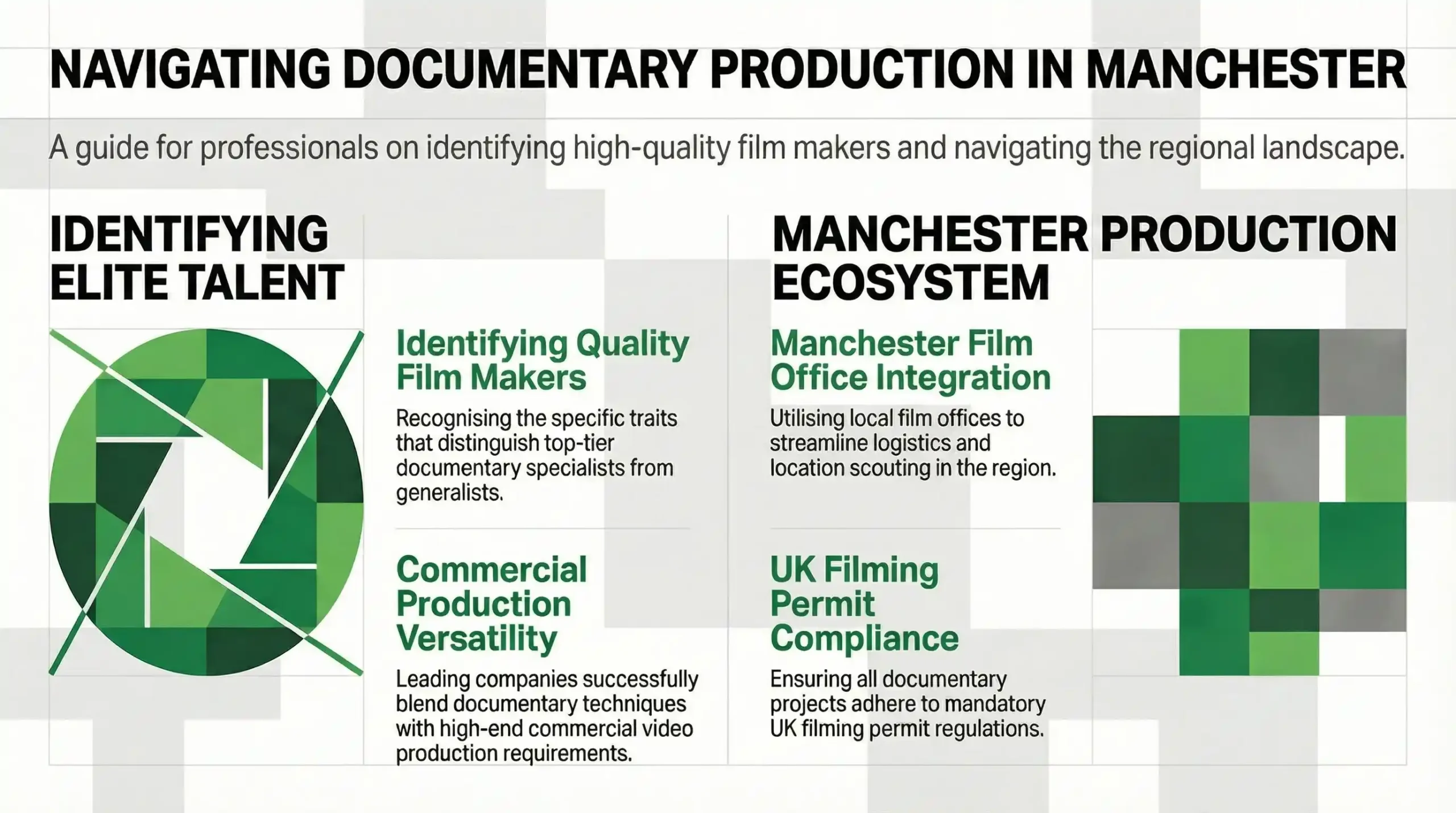
Navigate Local Regulatory Requirements
Secure Permits Through the Manchester Film Office
Professional filming in public areas requires formal coordination with the Manchester Film Office to ensure legal compliance. This process involves submitting risk assessments and proof of public liability insurance, typically at a minimum of £5 million. Reliable production companies in Manchester manage these administrative burdens to prevent project delays or shut-downs during filming.
Permits are mandatory for any shoot involving tripods, lighting rigs, or anything that restricts public access. An experienced agency handles all liaison with Manchester City Council and highways departments. This ensures location logistics are pre-approved and the production remains fully compliant with local bylaws.
Adhere to Public Liability and Safety Standards
A credible filmmaker must demonstrate a rigorous approach to health and safety, particularly in live urban environments. This requires written risk assessments and method statements. These must satisfy both the client’s internal safety officers and local authorities. Safety-first planning is a hallmark of an agency that values reputational security.
When filming in locations like parks or civic buildings, additional protections for the environment and the public are often required. High-quality agencies maintain insurance levels that exceed standard minimums. This provides an extra layer of protection in high-traffic or sensitive locations across Greater Manchester.
Define Broadcast Quality in Contemporary Filmmaking
Adopt TV-Grade Technical and Editorial Standards
Broadcast quality is defined by technical compliance, production discipline, and the ability to withstand external scrutiny without apology. It involves cinema-grade cameras, professional sound recording, and a controlled editorial logic that ensures messaging is clear and accurate. This level of quality is essential for brand-sensitive projects that target senior stakeholders.
Beyond the equipment, broadcast standards require a specialised crew, including dedicated cinematographers and sound recordists. This separation of roles reduces operational risk. Every technical aspect, from exposure to dialogue clarity, must satisfy audiences accustomed to high-end national broadcast standards.
Implement Professional Workflows and Quality Assurance
Structured workflows are necessary to manage the complexities of modern documentary production, from pre-production planning to technical finishing. Quality assurance stages, such as colour grading and professional audio mixing, ensure the final product reflects the organisation’s professional standards. This discipline prevents the inconsistencies often found in lower-tier, unmanaged video content.
A robust post-production workflow also includes version control and clear approval stages. This allows multiple stakeholders to provide feedback in an organised manner. The final film remains legally and reputationally safe. It stays aligned with the core strategic objectives defined at the outset.
Commercial Advertising
Cinematic & High-Impact
We produce high-gloss TV commercials and digital campaigns designed to captivate and convert. Our team manages the entire creative journey, from storyboard to broadcast, ensuring your brand message is delivered with world-class production values that cut through the noise.
Navigate Sensitive and Live Filming Environments
Manage Stakeholder Complexity in Public Sector Projects
Documentary projects in the public sector or infrastructure often involve navigating complex webs of stakeholders with varying priorities. A professional agency acts as a strategic partner, managing the politics and sensitivities of the environment while capturing authentic narratives. This requires discretion and a deep understanding of corporate governance and accountability.
Whether filming in schools, hospitals, or transport hubs, production teams must work around live operations without disruption. Building trust with non-media-trained subjects is critical. This ensures the resulting footage is both authentic and respectful of the individuals involved.
Ensure Safeguarding and Data Protection Compliance
Filming identifiable people in sensitive settings requires strict adherence to UK GDPR and safeguarding best practices. Professional agencies use formal appearance releases and clear consent processes. These protect the privacy of subjects and the legal standing of the client. This is particularly vital in education and healthcare environments.
Data protection extends to the secure storage and handling of footage. A reliable partner will have clear policies on data retention and access control, ensuring that sensitive recordings are not mishandled. This level of compliance is a non-negotiable requirement for any organisation operating in a regulated or high-profile sector.
Apply Documentary Techniques to Corporate Strategy
Utilise Narrative Frameworks for Brand Positioning
Documentary techniques, such as interviews and fly-on-the-wall footage, are powerful tools for humanising a brand and building trust. When used strategically, these elements can communicate complex values and missions more effectively than scripted advertisements. The goal is to create a connection that feels earned rather than forced.
Professional documentary film makers use narrative frameworks such as the challenge-solution-outcome arc to provide structure to real-world stories. This approach keeps content engaging whilst consistently reinforcing the primary messages the organisation needs to convey.
Balance Authenticity with Messaging Discipline
The primary value of documentary-style content is its perceived authenticity, but this must be balanced with strict messaging control. A professional filmmaker knows how to guide subjects to deliver natural responses that still align with the project’s commercial goals. This avoids the corporate feel of scripted content whilst maintaining strategic focus.
Maintaining this balance requires high-level editorial judgement. The agency must identify the most compelling human stories. It must ensure these do not drift from the brand’s core positioning. This ensures the final output is both emotionally resonant and strategically effective.
Corporate & Brand
Strategic Storytelling
We craft intelligent brand documentaries and corporate films for global organisations. Moving beyond standard interviews, we use authentic, broadcast-quality storytelling to communicate complex values to investors, stakeholders, and internal teams.
Measure Return on Investment and Business Value
Assess Indirect ROI Through Risk Reduction
The value of a professional documentary often manifests in indirect ROI. This includes time saved through clearer messaging or the reduction of reputational risk. By delivering a consistent message, organisations can reduce the need for repeated briefings. This efficiency gain is a significant driver of long-term commercial value.
In high-stakes environments, the cost of a misaligned or poor-quality video can be substantial. A professionally produced film provides a board-safe asset deployable with confidence across multiple channels. This protects the organisation’s credibility and ensures stakeholders receive a consistent, professional impression.
Extend Asset Lifespan via Content Repurposing
A strategic approach to production involves planning for multiple edits and versions from the outset. This significantly increases the ROI of a single shoot. Creating short-form cut-downs for social media alongside a hero film extends the lifespan of the initial investment across various platforms.
Modern agencies also use post-production techniques to refresh and update assets as the business evolves. This modular approach ensures a high-quality documentary remains relevant for years. It becomes a foundational piece of the brand’s communication library rather than a one-off expense.
Production Support
Regional Crew & Logistics
We act as a trusted “boots on the ground” partner for international agencies and broadcasters filming in the North. We provide elite-level crew hire, location logistics, and technical support to ensure your UK production runs seamlessly.
Integrate Modern Technology and AI Workflows
Accelerate Post-Production with AI-Enhanced Tools
AI technology is currently used by professional agencies to accelerate post-production tasks such as transcription, audio enhancement, and versioning. These tools allow for faster turnaround times and more efficient budget management without compromising the human-led creative direction. AI acts as an accelerator, ensuring that resources are focused on high-value creative decisions.
Using AI-assisted workflows also enables better accessibility, as tools can quickly generate accurate captions and subtitles. This is essential for compliance with digital accessibility standards. It ensures content is inclusive and reachable for the widest possible audience, regardless of platform.
Maintain Ethical Transparency in Synthetic Media
As AI becomes more prevalent, maintaining ethical transparency is vital to preserving trust. Professional documentary production companies use AI responsibly, ensuring that synthetic elements do not misrepresent real individuals or the brand’s integrity. Human oversight remains the critical safeguard in protecting the authenticity of the documentary format.
Agencies that prioritise ethical AI use will be transparent about where these tools have been applied. This is particularly important for organisations in high-trust sectors where the credibility of the message is paramount. Ethical technology use ensures that innovation supports the narrative rather than undermining its truthfulness.
Paper Films Clients
















Budget for Professional Documentary Projects
Account for Primary Production Cost Drivers
Documentary budgets are primarily driven by crew size, the number of shoot days, and the complexity of post-production. A professional quote should be itemised and transparent, reflecting the cost of specialist roles and high-end equipment. Understanding these drivers allows organisations to make informed decisions about where to allocate their resources.
Higher budgets often correlate with increased certainty and lower risk. Investing in a professional crew and a structured process reduces the likelihood of reshoots. It ensures the final output meets the required standards first time. This predictability is a key consideration for decision-makers managing fixed corporate budgets.
Protect Budgets Through Pre-Production Discipline
Effective pre-production is the most successful way to protect a project budget. By locking down the messaging, location logistics, and shoot schedule in advance, professional agencies prevent scope creep and late-stage changes. This discipline ensures that the project remains on track and delivers the expected value without unexpected costs.
Agencies that emphasise discovery and planning are better positioned to handle unforeseen challenges during production. This proactive approach to risk management protects the client’s investment. It ensures the final documentary is delivered on time and within the agreed financial framework.
Did You Know?
Screen Manchester, the city’s Film Office, requires all commercial permit applications to include evidence of Public Liability Insurance. A minimum threshold of £5 million applies for city-centre locations.
Summary of Documentary Production Essentials
Manchester’s ecosystem for documentary production companies continues to evolve, blending traditional storytelling with commercial rigour. To find the right partner, organisations must look beyond creative showreels. Assess an agency’s ability to manage risk, ensure compliance, and deliver measurable business outcomes. A strategic approach ensures your video is not just a story, but a high-value business asset.
The city’s elite documentary film makers offer more than technical skill. They provide the strategic oversight necessary to navigate complex regulatory and corporate landscapes. Select a partner that prioritises delivery certainty and broadcast-quality standards. Your project will resonate with stakeholders and stand the test of time.
Frequently Asked Questions
A:
A professional filmmaker is distinguished by their strategic approach, prioritising commercial objectives over purely creative goals. They demonstrate high standards of compliance and manage complex stakeholder environments with discretion. Broadcast-quality production values protect the reputational safety of the commissioning brand. A strong partner also holds established relationships with the Manchester Film Office, ensuring a smooth and legally permitted production process.
A:
Timelines vary, but a standard professional documentary typically takes eight to twelve weeks from discovery to final delivery. This includes pre-production planning and a structured post-production phase for editing and approvals. Projects requiring complex animations or extensive stakeholder sign-off may take longer. Define the schedule during the initial discovery phase to avoid delays.
A:
Permits are a legal requirement for commercial filming on council-owned land to ensure public safety and manage the city's streets. They require evidence of risk assessments and insurance. This protects both the filmmaker and the client from legal and financial liabilities should an incident occur. Filming without a permit in high-footfall areas like Manchester city centre risks a production shutdown. This wastes budget and causes reputational damage.
A:
Yes, professional agencies increasingly use AI as a workflow accelerator in post-production. This includes tools for enhancing audio, generating transcriptions, and creating multiple social media cut-downs efficiently. However, human editorial judgement remains essential to ensure brand alignment and ethical transparency. AI protects budgets and speeds up delivery. It does not replace the strategic thinking or human storytelling at the core of a high-quality documentary.
A:
Success is measured against the commercial objectives defined at the start of the project. Common KPIs include stakeholder sentiment, engagement rates, recruitment quality, or the achievement of a specific brand positioning goal. Indirect ROI, such as time saved or risk reduced, is also a critical metric. By defining success criteria early, agencies ensure that every creative decision serves the final intended outcome for the business.
